
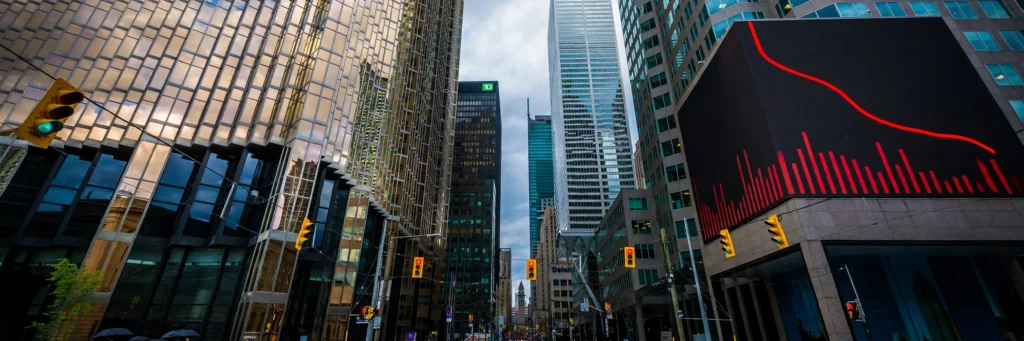
A week that wiped out months of gains
Canadian stocks have entered a correction. The S&P/TSX Composite Index closed at 33,189.85 on Friday, November 20, down 838.88 points, or 2.47 per cent, on the day, according to Dow Jones Market Data reported by Morningstar.
That close put the index 10.19 per cent below its record close of 36,957.63, set on Tuesday, August 25, 2026. A correction is commonly defined as a decline of at least 10 per cent from a recent peak.
The fall was not a one-day event. The index was down 2,916.05 points, or 8.08 per cent, for the week — its largest one-week percentage decline since the week ending March 20, 2020. It has now fallen for seven consecutive trading days, and it is down 8.85 per cent over the last seven sessions.
Despite the selloff, the index remains up 4.66 per cent for the year, and it is still more than 10 per cent above its level a year ago. The correction, in other words, has erased the gains of the late summer and autumn, but not the gains of the year as a whole.
Metals led the slide
Materials were the biggest drag on the market. Gold, silver and base metals all fell sharply, and the mining companies that make up a large part of the Toronto Stock Exchange fell with them.
On Wednesday, November 18, the index fell 737.25 points, or 2.09 per cent, to 34,578.05, its fifth straight losing session. Materials stocks dropped 5.4 per cent that day and energy fell 3.8 per cent as gold, copper and oil prices slumped, according to market reporting.
Thursday brought little relief. The index fell 549.32 points, or 1.6 per cent, to 34,028.73, its lowest close since May 19, according to Reuters reporting carried by Kitco. The materials sector fell 2.9 per cent, and shares of Seabridge Gold tumbled 29.3 per cent to their lowest close since September 2025.
Friday was worse again. Gold fell to a 14-month low, and the U.S. dollar strengthened on expectations that the U.S. Federal Reserve could raise interest rates again in December. Gold, which does not pay interest, tends to fall when rate expectations rise.
Copper also slid, with December copper futures down 1.8 per cent on Friday. The base-metals group fell 2.7 per cent, while gold dropped 3.5 per cent and silver sank 5.8 per cent.
Tech joined the selloff
Technology shares were the other major drag. The TSX technology sector lost 3.3 per cent on Thursday, with shares of e-commerce company Shopify falling 5.2 per cent, according to Reuters.
The tech selloff was part of a global shift in sentiment about artificial intelligence. Investors have been questioning the pace and financing of AI infrastructure spending, and AI-linked stocks have been volatile. Celestica, a major Canadian supplier of networking and data centre hardware, was among the hardest-hit large names earlier in the week.
In the United States, the mood was even darker on Friday. The S&P 500 fell 3.70 per cent, the Dow Jones Industrial Average lost 1.93 per cent, and the Nasdaq Composite fell 5.28 per cent. Anthropic’s debut on the Nasdaq failed to revive enthusiasm for AI stocks.
What to watch next
The TSX is heavily weighted toward energy and materials, which together account for roughly a third of the index, so it remains particularly sensitive to commodity prices and global risk appetite. The question now is whether buyers return on Monday, or whether the selling continues into a second week.