
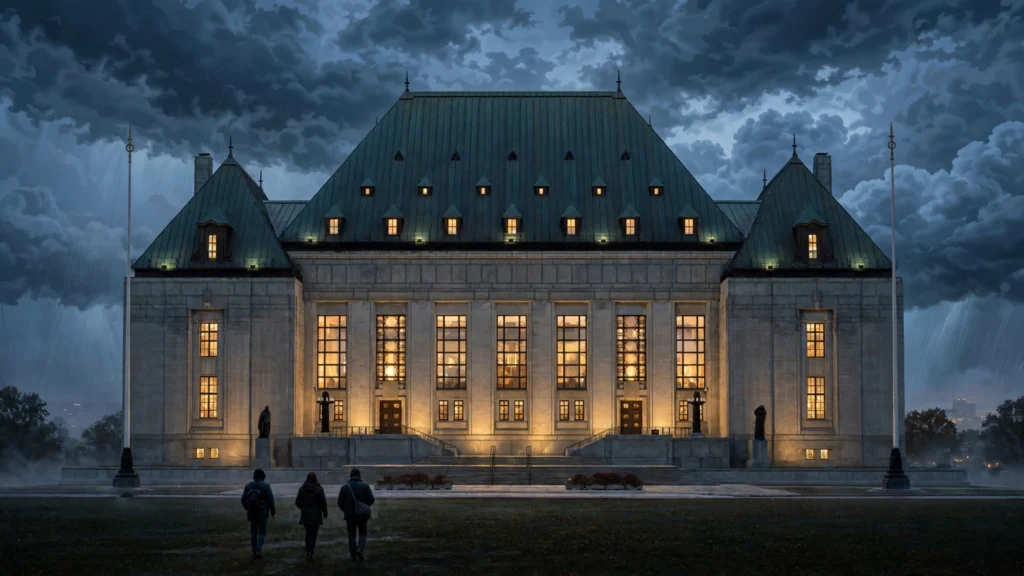
Canada’s Supreme Court has upheld Quebec’s secularism law, Bill 21, ending a legal fight that lasted more than seven years and settling – for now – the biggest question in Canadian constitutional law: how far can a government go when it uses the notwithstanding clause to shield a law from Charter challenges?
The court released its decision on Friday morning in English Montreal School Board v. Quebec (Attorney General), 2026 SCC 41. The ruling confirms that the Act respecting the laicity of the State is valid and in force, with one narrow exception. The part of the law that bars people from covering their faces inside the National Assembly cannot be enforced against elected members of the legislature, because it infringes their democratic rights.
Everything else in the law stands.
What Bill 21 actually bans
Quebec passed Bill 21 in June 2019 under the Coalition Avenir Quebec government of Francois Legault. The law bars public servants in positions of authority from wearing religious symbols while they are on the job. That covers public school teachers, principals and vice-principals, police officers, Crown prosecutors, judges and lawyers acting for the state, among others. A hijab, a turban, a kippah or a cross worn at work is prohibited for those workers.
The law was shielded from the start. When Quebec passed it, the National Assembly invoked section 33 of the Canadian Charter of Rights and Freedoms, the notwithstanding clause, and the matching override in Quebec’s own Charter of human rights and freedoms. The override lasts up to five years and can be renewed. Quebec renewed it in 2024, and it comes up for renewal again in 2029.
Teachers, religious organizations and civil liberties groups challenged the law almost immediately. The challengers included the English Montreal School Board, the National Council of Canadian Muslims, the Canadian Civil Liberties Association and the World Sikh Organization. Quebec’s Court of Appeal upheld most of the law in February 2024, and the Supreme Court heard the case over four days in March 2026.
The notwithstanding clause was the real fight
The fate of Bill 21 itself mattered enormously in Quebec. But the question the whole country was watching was bigger: what limits, if any, apply when a government invokes the notwithstanding clause?
Chief Justice Richard Wagner wrote the lead reasons, joined by Justices Suzanne Cote and Malcolm Rowe. His reasons reaffirmed the court’s 1988 decision in Ford v. Quebec. Section 33, he held, imposes only formal requirements: an express declaration that names the Charter provisions being overridden, and an expiry after five years unless the declaration is renewed. Beyond that, the exercise of the override power is not subject to any other limit in the text of the provision.
The court also ruled that governments can invoke the clause pre-emptively, before any court has decided whether the law violates the Charter. Quebec did exactly that in 2019, and the court said that was valid.
Four of the seven judges dissented in part, and the court split over whether judges can still say anything about a law shielded by the clause. Justices Andromache Karakatsanis, Michelle O’Bonsawin, Nicholas Kasirer and Sheilah Martin each wrote that superior courts keep the power to declare that a law protected by the notwithstanding clause infringes Charter rights, even though such a declaration would not strike the law down. Kasirer and the joint reasons of Karakatsanis and O’Bonsawin went further and would have issued that declaration in this case. They found that sections 6 and 8 of Bill 21 unjustifiably infringe freedom of religion, freedom of expression and equality rights. As they put it, those sections put devout Quebecers in a terrible dilemma: betray their religious convictions or be excluded from avenues of public service and employment. The law remains valid because of section 33, they concluded, but the court should have said so plainly.
In the end, the court did not make any declaration of inconsistency in this case.
The two arguments the court rejected
The challengers also argued that the law violated section 28 of the Charter, which says Charter rights apply equally to men and women. They said the ban falls hardest on Muslim women, who are the most visible group affected. The court rejected that argument by a 4-3 margin, holding that Bill 21 cannot be invalidated because of section 28.
The English Montreal School Board argued separately that the law interfered with its constitutionally protected right to manage its own schools, and with the rights of Quebec’s English-speaking minority in education under section 23 of the Charter. The court found the hiring and retention problems the board pointed to had not been shown to undermine the specific linguistic or cultural interests of the minority. The board’s challenge failed.
A separate challenge by the Federation autonome de l’enseignement, a teachers union, over two surveys Quebec’s Education Ministry conducted in late 2018 and early 2019, before the law was adopted, was also rejected.
The one part Quebec lost
The single defeat for Quebec concerns elected members of the National Assembly. Section 8 of the law, as it applies to them, infringes the democratic rights set out in section 3 of the Charter. The court ruled that Quebec cannot prevent an elected representative from taking part in the legislature because that person’s religious beliefs require them to cover their face. That provision is now of no force or effect, but only as it applies to members of the National Assembly.
What the reaction says about what comes next
Prime Minister Mark Carney said his government was studying the ruling closely, including its potential implications for the rest of Canada. The decision lands at a difficult moment for him. He has been trying to hold the country together through a trade war and annexation threats from the United States, and the ruling hands Quebec’s sovereigntist government a major win.
Quebec Premier Paul St-Pierre Plamondon, who leads a minority Parti Quebecois government, had said before the ruling that he opposed any decision invalidating parts of Bill 21. His government is now preparing to extend the ban on religious symbols to elementary school students, a step that would widen the law well beyond the public servants it covers today.
The reaction from the challengers was bitter. English Montreal School Board chairman Joe Ortona said he was disappointed with the ruling, while defending the more than $1 million the board spent fighting the law. As he put it, you can’t put a price tag on standing up for vulnerable and marginalized people. He also pointed out that Quebec now has a minority government, and the notwithstanding clause invocation comes up for renewal in 2029.
The Canadian Civil Liberties Association said Bill 21 had already denied a generation of Quebecers the chance to pursue their chosen careers in public service because of their religious beliefs, and vowed to keep fighting the growing use of the notwithstanding clause to override fundamental freedoms. Montreal lawyer Michael Bergman, a longtime advocate for minority and language rights, called the Charter an empty shell after the ruling, arguing that governments could now make fundamental rights disappear with what he called a magic wand.
Why this ruling reaches far beyond Quebec
The federal government had urged the court to impose new limits on the override, while five conservative premiers publicly opposed Ottawa’s intervention. The court ultimately kept the permissive reading from 1988. That means any province can now invoke the notwithstanding clause in the same way Quebec did, shield a law from Charter challenges for five years at a time, and renew the shield indefinitely, as long as it follows the formal steps.
For Quebec, the ruling settles the law for now, but not the politics. The ban stays in force, the government wants to extend it to schoolchildren, and the next test comes in 2029, when the override must be renewed by a minority government in a province where the secularism law remains one of the most divisive issues in public life.
Related reading
Alberta to invoke Sovereignty Act in fight over Ottawa’s hate law