
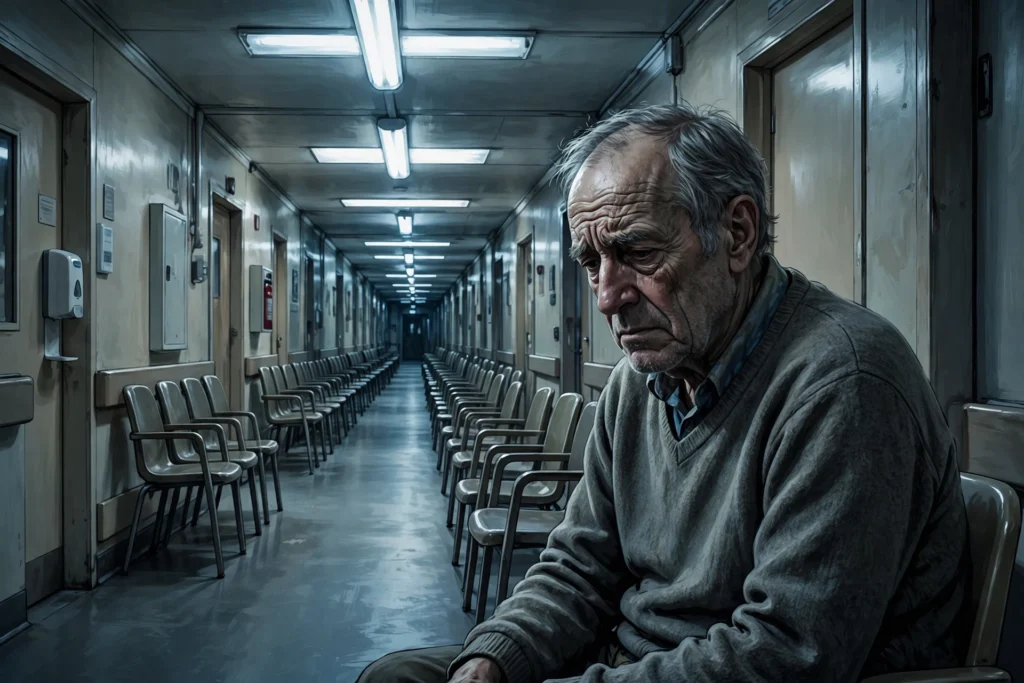
Nearly 130,000 Canadians died waiting for medical care over the past eight years, according to new figures built from government records. SecondStreet.org, a Calgary-based think tank, says at least 129,892 patients died while on a waiting list for surgery, a procedure, a diagnostic scan or a specialist appointment between April 2018 and March 2026.
In the fiscal year from April 1, 2025 to March 31, 2026, at least 29,468 appointments were cancelled because the patient had died before the date arrived. That is the highest annual total the group has recorded, although more health authorities supplied data this year than in past years.
How many Canadians died waiting for medical care
Most of the people counted in the latest year were not waiting for an operation. Of the 29,468 cases, 5,931 were waiting for surgery or a medical procedure, while 23,537 were waiting for a diagnostic scan or a specialist appointment. The cases ranged from potentially lifesaving heart surgery to joint replacements and cataract surgery.
The figures were gathered through freedom of information requests filed in April 2026 with more than 30 government health departments, health authorities and health regions across Canada. The report says the true number is likely higher, because many health bodies do not track this information or share complete data. Newfoundland and Labrador refused to provide its figures at all.
Where the deaths were recorded
Quebec recorded the largest provincial total, with 11,548 cases, followed by Ontario with 10,376 and British Columbia with 4,365. Alberta recorded 878, Saskatchewan 428, Manitoba 396, Nova Scotia 1,205, New Brunswick 91 and Prince Edward Island 181. The report warns against ranking provinces against each other, because each one supplied different kinds of data.
Manitoba’s surgical waiting list deaths nearly doubled, rising from 163 to 316. Ontario recorded 115 cancer surgeries cancelled because the patient died before treatment. Alberta recorded 52 cardiac waiting list deaths, and cancer-related cases in Saskatchewan rose from 86 to 111.
What the numbers do not prove
Dying while waiting for care does not necessarily mean the wait caused the death, and the report itself does not claim that it did. None of the health bodies that supplied the data provided a full analysis of how often a delay contributed to a death. That gap in the evidence is the report’s most important limit.
Critics have pushed back. Natalie Mehra, executive director of the Ontario Health Coalition, has said the report overstates the problem by counting deaths that had nothing to do with waiting times.
SecondStreet.org president Colin Craig argues that the lack of official tracking is itself the problem. “You can’t solve problems if you don’t look at them carefully,” he told CTV News. He wants governments to track, analyze and publish waiting list deaths every year. An October 2026 Leger poll found that 18 per cent of Canadians personally knew someone who had died because of a long wait in the health care system.
Waits are getting longer, not shorter
The new figures arrive just over a week after the Fraser Institute reported that Canada’s median wait from a family doctor referral to treatment hit a record 30.7 weeks in 2026, up from 28.6 weeks in 2025. The same study estimated that patients across the country were waiting for about 1.46 million medical procedures. Canadians are also watching other health warnings, including a recent Health Canada warning about vision loss linked to Ozempic and Wegovy.
Waiting also costs families money, through time off work, travel to appointments and care at home. Federal benefits and payment dates can help some households cover part of that gap, and some families also set money aside for unexpected costs using the TFSA limit for 2027.
What happens next
SecondStreet.org is calling for more than better counting. Its report recommends linking hospital funding to services delivered, expanding partnerships with private providers, giving patients more treatment choices and offering reimbursement for care received outside their home province. Whether any province takes up those ideas remains to be seen. No government publishes this figure on its own, and the report says the gaps in the data mean the real total is almost certainly higher than 129,892.