
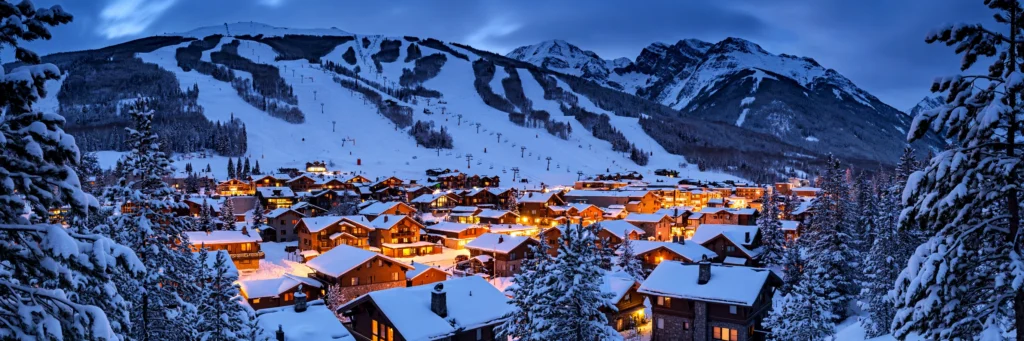
Canada’s best winter trips do not start in a big city. They start in a small town at the bottom of a mountain, where the main street is a short walk from the lifts and the snow is part of daily life. Most ski resorts open in late November or early December and run to mid-April, and February and March bring the deepest snow.
Here are the seven best small towns in Canada to visit in winter, from the biggest resort in North America to the quietest corner of the Rockies.
1. Whistler, British Columbia
Whistler Blackcomb is the largest ski resort in North America, with 3,307 hectares of terrain across two mountains and more than 200 marked runs. The vertical drop is 1,609 metres, and the Peak 2 Peak gondola links the two summits in about 11 minutes.
The village itself is car-free, with shops, restaurants and hotels at every budget, and it is about two hours from Vancouver on the Sea-to-Sky Highway. It is the liveliest ski town in the country, and the best choice if you want big-mountain skiing with a real town attached. Rooms are expensive at Christmas and in February, so book early or visit midweek in January.
2. Revelstoke, British Columbia
Revelstoke is the powder town. Its resort has the longest lift-served vertical in North America at 1,713 metres, with an average of 1,049 centimetres of snowfall a year, and the terrain is built for advanced skiers — steep bowls, gladed tree skiing and long fall-line runs through old-growth forest.
The town sits in the Columbia River valley, about ten minutes from the resort base, and it is one of the few places in the world where you can ski lift-served runs, cat-ski and heli-ski from the same base in the same week. Come here for deep snow and a real small-town feel, not resort polish.
3. Banff, Alberta
Banff is the classic. The town sits inside Banff National Park, and its three ski areas — Banff Sunshine, Lake Louise and Mt Norquay — are all covered by a single SkiBig3 pass, with buses running from hotels in town. Banff Sunshine sits at a 1,660-metre base elevation, the highest in the Canadian Rockies, which means dry snow and a season that often runs into late May.
Downtown Banff hosts the SnowDays Festival in winter, with ice sculptures and family events, and the town itself is a National Historic Site. Banff also hosts one of the best Christmas markets in Canada. It is the best pick if you want scenery, variety and a town that is worth visiting even on a rest day.
4. Jasper, Alberta
Jasper is Banff’s quieter neighbour, and that is the point. Marmot Basin, the local hill, has 91 runs across 1,720 acres and a fraction of Banff’s crowds, with wide-open runs and tree skiing in a national park setting.
Jasper is also a Dark Sky Preserve, so on a clear winter night the stars are as much of an attraction as the slopes. The town is about ten to fifteen minutes from the hill, the season runs from early November to late April, and the pace is slow in the best way. Choose Jasper if you want the Rockies without the rush.
5. Mont-Tremblant, Quebec
Mont-Tremblant is the east’s answer to a European ski village. The resort has 102 runs and 645 metres of vertical, and the pedestrian village at the base is packed with ski-in, ski-out hotels, restaurants, shops and cafés.
It is about 90 minutes from Montreal, the season usually runs from late November to early April, and the Québécois food and atmosphere make it feel like a different country from the western resorts. It is the best choice for skiers in Ontario and Quebec who do not want to fly west.
6. Fernie, British Columbia
Fernie is the town for people who like their ski trips with a side of local character. The resort has 1,082 metres of vertical, 1,013 hectares of terrain and an average of 875 centimetres of snowfall, with terrain that suits intermediates especially well.
The town itself is a former coal-mining community with a historic main street, and it sits on the Powder Highway, the loop of Kootenay resorts that includes Kicking Horse, RED Mountain and Whitewater. Fernie is the pick if you want great snow, a real town and prices that are kinder than Whistler’s.
7. Blue Mountain, Ontario
Blue Mountain, by Collingwood on Georgian Bay, is Ontario’s answer to a ski town. The resort is the province’s largest, with a village of shops, restaurants and hotels at the base, and the season typically runs from December through March.
It is about two hours from Toronto, which makes it the easiest winter mountain trip in the country for the millions of people in southern Ontario. It is not the biggest or the steepest hill on this list, but it is the one you can visit for a weekend without booking a flight.
Planning your winter town trip
A few things to keep in mind. Lift tickets at the big western resorts run about $130 to $200 a day, and much less at smaller hills, so a multi-day pass usually pays for itself. February and March bring the deepest base, while January is quieter and cheaper. And if you are driving, check road conditions before you leave — mountain passes can close in a storm, and winter tires are not optional.
Pick the town that matches how you ski, not the one with the biggest numbers. A quiet hill you enjoy beats a famous one you spend all day queuing for. If a move is on your mind rather than a holiday, our list of the cheapest cities to live in Canada compares costs across the country.
Frequently asked questions
When does ski season start in Canada?
Most resorts open in late November or early December and run to mid-April. Banff Sunshine often runs into late May, and Whistler’s glacier skiing can stretch into spring.
Which small town is best for families?
Whistler has the most to do off the slopes, and Big White and Sun Peaks in the B.C. Interior are built for families, with ski-in, ski-out lodging and uncrowded runs. Banff is also a strong family pick, with three hills on one pass.
Which small town has the most snow?
Revelstoke averages about 1,049 centimetres a year, the most on this list, and Whistler averages about 1,164 centimetres. Fernie is close behind at 875 centimetres.
Do I need a car?
Whistler has frequent shuttles from Vancouver, and Banff has buses from Calgary and between its three hills. Revelstoke, Fernie and Jasper are easier with a car, especially if you want to explore nearby resorts.