
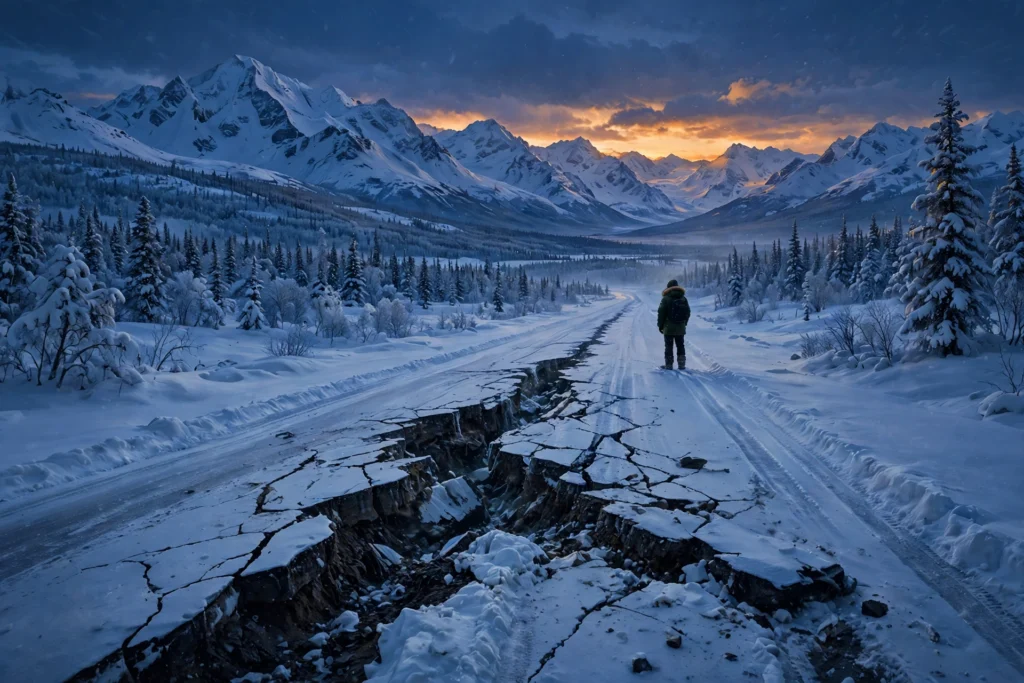
A magnitude 5.4 earthquake shook the Yukon on Saturday afternoon, rattling homes for about 30 seconds and sending the tremor hundreds of kilometres to Whitehorse.
Earthquakes Canada recorded the quake just after 1 p.m. local time, about 47 kilometres south-southwest of Watson Lake, at a depth of 18 kilometres. The shaking was strong enough to swing lights, knock pictures off walls and leave people in the small town wondering what had hit them.
Carmen Charlie was sitting in her living room with her husband in Watson Lake when the ground started to move.
“It was just like a loud rumbling noise underneath us and the whole house shook,” she said. “I got weak in the knees. It was a very scary feeling.”
Mary Palmer, also in Watson Lake, thought something far more ordinary had gone wrong at first.
“Our mobile home shook violently for about 30 seconds. I thought a truck had hit the house,” she said. “It was very loud.”
Others had the same confusion. On social media, several people posted that they first thought an unbalanced washing machine was shaking their home, until pictures started falling off the walls and the rumbling kept going.
Natasha Stoneman was at a book fair in Watson Lake when the shaking hit.
“What I can say is that no one here is prepared,” she said. “I got under the table and advised the other two people there to do the same and they wouldn’t. They had no idea what to do.”
Yukon earthquake felt as far away as Whitehorse
The tremor did not stay in Watson Lake. People reported feeling it in Dease Lake, Good Hope Lake and Lower Post in northern British Columbia, and in Upper Liard, Teslin and Whitehorse in the Yukon. Whitehorse sits hundreds of kilometres from Watson Lake, which shows how far the shaking travelled.
As of Saturday evening, no injuries or damage had been reported. Emergency officials said people who felt the shaking should check their homes for cracked walls, fallen items and gas leaks, and follow any advisories from local authorities.
The epicentre was not in the Yukon at all
Here is the twist in the story. The quake carries the name of the Yukon town, but its epicentre was not in the Yukon. Earthquakes Canada lists the event in its British Columbia seismological region, and the coordinates place it just south of the 60th parallel, the line that marks the boundary between the Yukon and British Columbia.
That means the earthquake that shook the Yukon technically started in northern B.C., about 47 kilometres from the town it is named after.
The Yukon records a few hundred earthquakes every year, according to the Yukon government. But a moderate quake above magnitude 5 comes only once every few years, which makes Saturday’s shaking a rare event for the territory.
EmergencyInfoBC, the B.C. government’s emergency information service, posted guidance after the quake. Anyone who feels shaking should drop, cover and hold on, wait for the shaking to stop and then count to 60 before getting up. People should move carefully and check for unstable objects and other hazards, and if they smell gas they should leave the building right away and call 911 or their gas company.
Aftershocks could follow, officials warned, and anyone who feels more shaking should drop, cover and hold on again. People who felt the quake are asked to report it to Earthquakes Canada, and not to call 911 just to report that they felt it.
It has been a rough stretch for natural hazards in the west. Floods forced families out of their homes on Vancouver Island earlier this week, and the B.C. coast was hit by a second major storm days earlier. Saturday’s earthquake is a reminder that the shaking can arrive with no warning at all.
This article will be updated as officials release more information.