
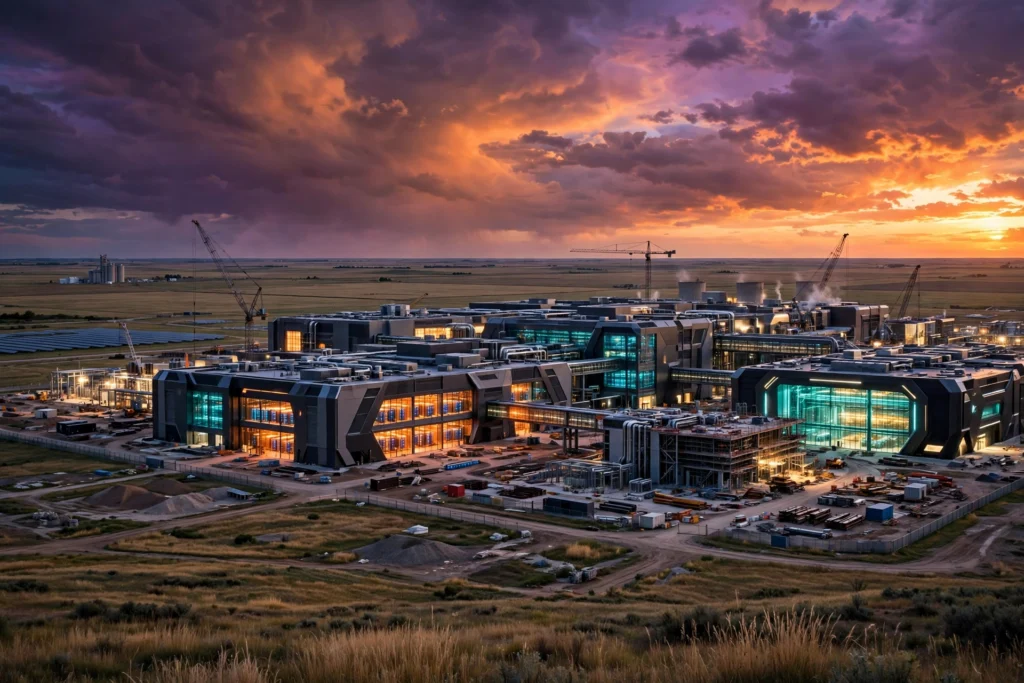
Bell’s giant AI data centre outside Regina was supposed to be a clean good-news story for Saskatchewan. Billions in investment, hundreds of jobs, and a made-in-Canada home for artificial intelligence. Now it has its first real fight, and it is coming from the First Nation whose territory the campus sits on.
Bell’s chief executive, Mirko Bibic, admitted as much on the company’s third-quarter earnings call this month. The $50-billion project just south of Regina already has more than 1,100 workers on site, he told analysts, and he acknowledged opposition from some local communities.
“We can’t lose sight of the broader endorsement of this project and at the same time, we do have to address the concerns that are arising in some segments,” Bibic said. He added that the community in and around Regina and the Rural Municipality of Sherwood is broadly supportive.
The concern comes from the Standing Buffalo Dakota Nation, about 75 kilometres northeast of Regina. Its Chief, Rodger Redman, wrote to Bell last month saying the campus is being built on the First Nation’s unceded traditional territory. He asked the company to hand over technical reports and approval records so the First Nation could do its own review of the project.
Bell replied with information about the data centre’s possible environmental effects, from water use and cooling systems to power generation, and invited Redman to keep talking. The company also said it had already done the consultations the province asked of it. Redman has said the details he asked for are still incomplete.
Not every nearby First Nation is opposed. Bibic said the George Gordon First Nation, north of Regina, supports the project and that Bell is working in partnership with the community so it benefits directly through jobs and other co-development ideas. He also said Bell has signed on to the federal and provincial governments’ principles for responsible AI data centre development, and plans to respect them in how it builds and runs the sites.
The campus, called Bell AI Fabric, sits in the Rural Municipality of Sherwood, just outside Regina. Bell announced the first phase in March: a 300-megawatt facility costing about $1.7 billion, with the first data hall due to come online in the first half of 2027. Two American AI firms, Cerebras and CoreWeave, are signed on as tenants. Bell said at the time the finished project could create up to 600 permanent operations and management jobs, and support 3,000 more jobs off site and in the community.
Then in September, Bell quadrupled the plan. In a deal with the Saskatchewan government, announced alongside Prime Minister Mark Carney and Premier Scott Moe, Bell said it would add up to 900 megawatts more in phases, taking the campus toward 1.2 gigawatts of computing power. The full build-out, including the data centre buildings, the power generation and the computing hardware tenants will install, could cost more than $50 billion. Bell called it the largest capital investment in Saskatchewan’s history.
The expansion will not draw all of its power from the provincial grid the way the first building does. Bell plans to work with natural gas power providers to generate electricity behind the meter, and says the new facilities will use closed-loop cooling that needs no municipal water.
The Saskatchewan campus is only part of Bell’s bet. The company is building a cluster of AI data centres in British Columbia too, with 500 megawatts of capacity backed by hydro power, including a facility in Merritt that is due to open in the coming weeks. On November 5, Bell also signed a strategic alliance with TC Energy, under which Bell will lead the building and running of AI data centres while TC Energy leads the power generation behind them.
The push into AI is now core to Bell’s business. Revenue from its business markets division, which covers telecom and AI services together, was $1.12 billion in the latest quarter, up 9.2 per cent from a year earlier. Revenue from AI-powered services alone jumped 41 per cent, driven by demand for its Ateko and Bell Cyber brands. Bell has said it wants to reach $2 billion a year in revenue from AI-powered services by 2028.
Paying for it is another story. Bell is selling assets to cut its debt, including a 49.9 per cent stake in a new company that will own its wireless towers, sold to Quebec investment manager La Caisse for $2.45 billion. The deal is expected to close in early 2027, and analysts say the money will help fund more data centre capacity in Saskatchewan. Bell is also selling its land mobile radio business to a Motorola Solutions division for $675 million, part of a plan to sell $7 billion in assets.
The same earnings call saw Bibic criticize the regulator, after the CRTC moved against the fees Bell, Rogers and Telus charge on new phones. Bell has argued the rules are hurting the big carriers’ ability to invest in their networks. Bell also confirmed a cyberattack on its business customers earlier this month.
For now, construction on the first 300 megawatts keeps going, with the first hall still on track for the first half of 2027. The bigger question is whether the expansion to 1.2 gigawatts moves as fast. Bell says the extra phases will go ahead as customer commitments are secured. The Standing Buffalo Dakota Nation is still waiting for the full picture it asked for, and that conversation is far from over.