
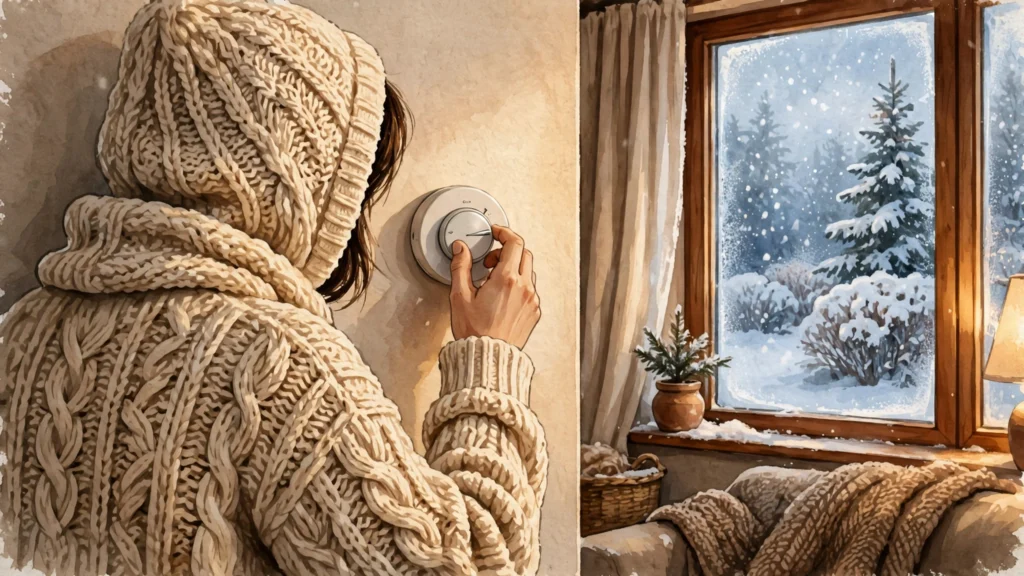
Heating is the biggest line on a Canadian winter energy bill by a wide margin. Natural Resources Canada says about 61 percent of the energy used in the average Canadian home goes to heating, and space heating alone costs the average homeowner more than $1,113 a year, more than half of the home’s total energy bill.
The good news is that most of the savings are simple, and the best ones cost nothing. These seven moves are ranked from free to bigger spending, so start at the top and work down.
1. Turn the heat down when you sleep or leave
This is the single biggest free saving in the house. Natural Resources Canada’s rule of thumb is that every degree you turn the heat down saves about 2 percent of heating energy for each eight hours it stays down. Drop the temperature by one degree all day, all winter, and that is roughly 6 percent off your heating costs. Drop it three degrees while you sleep and three degrees while you are at work, and the saving roughly doubles.
The department’s guide is simple: set the thermostat to 17°C when you are sleeping or not at home, and 20°C when you are awake and at home. Do not go below 17°C in unused rooms, because moisture can build up in exterior walls. A sweater and a blanket make 17°C comfortable overnight, and the house warms up again before you need it to.
2. Let a smart thermostat do the remembering
A programmable or smart thermostat does the setback for you, every day, without you having to think about it. Natural Resources Canada says an ENERGY STAR certified smart thermostat can reduce a home’s energy consumption by at least 8 percent. Hydro-Quebec puts the heating saving at up to 10 percent a year.
The catch is that the gadget only saves money if you actually program it. Set the schedule once, with lower temperatures overnight and while you are out, and leave it alone. A smart thermostat you never program is just an expensive dial on the wall. If you heat with electric baseboards, make sure you buy a line-voltage model, because the common low-voltage smart thermostats are the wrong product for baseboards.
3. Seal the drafts
Windows and doors can be responsible for up to 25 percent of a home’s total heat loss, according to Natural Resources Canada. On a windy night, hold your hand near a window frame or under a door and you can feel the warm air leaving.
Weatherstripping and a tube of caulk cost about $50 at a hardware store, and a weekend of work can make a real difference in a leaky house. Seal the gaps around windows and doors, put plastic film on the worst windows, and do not forget the attic hatch, which is one of the most overlooked leaks in the house. Hydro One says caulking, weatherstripping and insulating together can cut heating and cooling bills by as much as a quarter.
4. Change the furnace filter
A dirty furnace filter makes the furnace work harder to push warm air through the house, and it is the most forgotten maintenance job in the home. Natural Resources Canada says to clean or change the filter every three months, or sooner if you cannot remember the last time you did it.
It takes five minutes and costs a few dollars. Your furnace manual will say how often to change the filter for your specific model, but three months is the rule if the manual is long gone. While you are there, book the yearly furnace service too, because a serviced furnace runs the way it was built to run and problems get caught before a cold snap.
5. Clear the vents and move the furniture
Warm air cannot heat a room if it cannot get out of the vent. Walk through the house and check that no vent or radiator is blocked by a couch, a bookshelf, a rug or a pile of winter boots. Move furniture a few centimetres away from heat sources so the air can circulate, and vacuum the radiators so they can fill fully with water.
If you have radiators, bleed the air out of them once or twice a year so they fill completely, and insulate any exposed hot water pipes. These are ten-minute jobs that cost nothing and make the heat you are already paying for reach the rooms it is meant for.
6. Use the sun and your curtains
Your windows are free heaters on a sunny winter day and free leaks at night. Open the curtains or blinds in the morning to let the sunlight in and warm the rooms for free, then close them at dusk to hold the heat inside. Window coverings reduce energy loss through the glass, and heavy curtains on the coldest windows work even better.
The same logic applies to the rooms you do not use. Close the door and set that room’s thermostat back, but keep it at about 17°C so the pipes stay safe. An open door is not a zone, and heating a guest room nobody sleeps in is money out the window.
7. Reverse the ceiling fan
A ceiling fan is not just for summer. In winter, change the direction so it spins clockwise, which pulls the cold air up and pushes the warm air that collects near the ceiling back down to where you sit. It costs nothing, takes a minute, and makes the room feel warmer at the same thermostat setting.
Check that the fan has a reverse switch, usually on the motor housing, and flip it when the heating season starts. Flip it back in the spring.
What to do this week
Start with the three free moves: set the thermostat schedule, clear the vents, and reverse the ceiling fan. That is an evening of work and no spending. This month, change the filter, seal the worst drafts, and look at a smart thermostat if your schedule is irregular. The bigger jobs, attic insulation and new windows, can wait until you have the cheap savings banked, and a tighter house needs less heating equipment when you do get there.
If the January bill still stings, ask your gas or electricity provider about a budget billing plan. It does not reduce what you pay, but it spreads the cost evenly across the year so the biggest bill of the year does not land in February when the holidays have already been paid for. For more household savings, see the Canada Groceries and Essentials Benefit and the cheapest cities to live in Canada.
Frequently asked questions
Q: How much can I really save on my heating bill?
A: It depends on the house, but the official figures give a sense of scale. A one-degree setback all winter saves about 6 percent of heating energy, and a three-degree setback while you sleep and work saves roughly twice that. A smart thermostat adds at least 8 percent, and sealing drafts can cut heating and cooling bills by up to a quarter in a leaky home.
Q: What temperature should I set my thermostat to in winter?
A: Natural Resources Canada recommends 20°C when you are awake and at home, and 17°C when you are sleeping or away. Do not drop unused rooms below 17°C, because of moisture in exterior walls.
Q: Do smart thermostats really save money?
A: Yes, if you program them. Natural Resources Canada says an ENERGY STAR certified smart thermostat can cut home energy use by at least 8 percent, and Hydro-Quebec says up to 10 percent on heating. The saving comes from the schedule, not the gadget, so set it and leave it alone.