
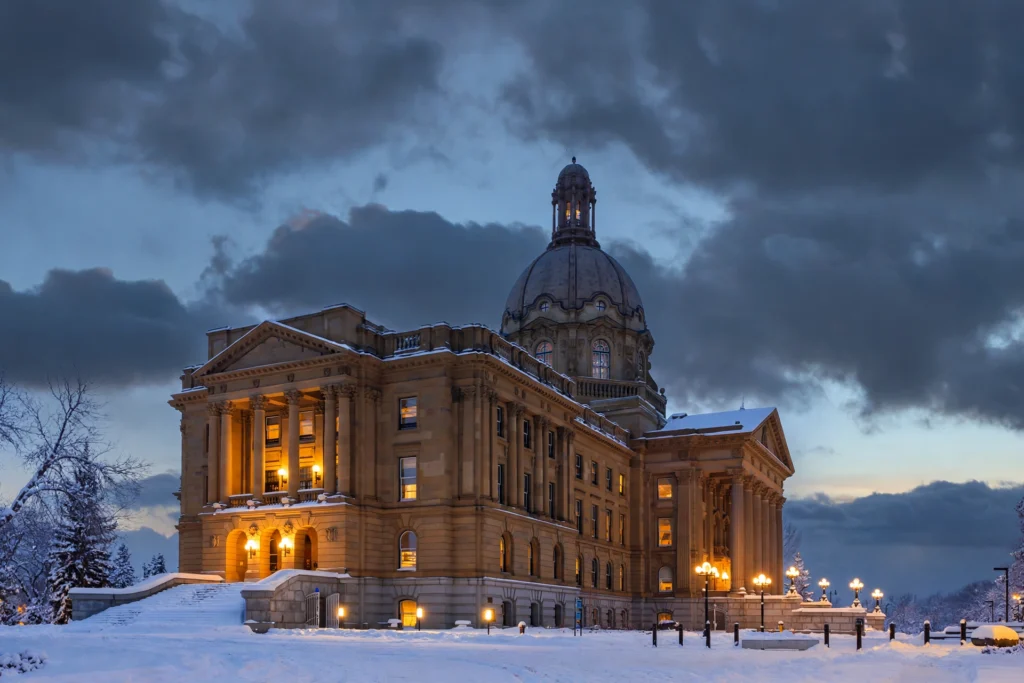
Alberta is turning to its Sovereignty Act again, this time to challenge a federal hate law that the province says threatens freedom of speech and religion.
Premier Danielle Smith and Justice Minister Mickey Amery announced on Tuesday that the government will introduce a motion under the Alberta Sovereignty within a United Canada Act, aimed at Ottawa’s Combatting Hate Act. The motion is expected to be tabled in the legislature, and could reach the floor as early as Tuesday evening.
At the centre of the dispute is a change Ottawa made to the Criminal Code earlier this year. The Combatting Hate Act, originally introduced as Bill C-9, received royal assent on June 18 and came into force on July 18. Among other things, it repealed a long-standing defence that let a person accused of certain hate propaganda offences argue they had expressed a religious opinion in good faith.
Why Alberta is pushing back
Smith says removing that defence creates uncertainty about lawful religious speech, and could discourage people from speaking openly about their faith. She has said she worries pastors could be “hauled off to jail” for expressing their beliefs.
The province says the motion would ask cabinet to look at lawful ways to shield Albertans from the federal law, and to direct the government to oppose or resist federal measures it believes infringe on constitutionally protected freedoms. The motion addresses people of all faiths in Alberta, including clergy and worshippers.
The Alberta Sovereignty within a United Canada Act, passed in 2022, lets the provincial legislature consider resolutions asserting that a federal initiative is unconstitutional or harmful to Alberta’s interests. This is not the first time the province has turned to the act to push back against Ottawa.
What the federal law does
The Combatting Hate Act also created new Criminal Code offences for intimidating or obstructing people trying to reach places of worship, schools, community centres and other places used mainly by identifiable groups. Ottawa has said the removal of the religious-opinion defence does not criminalize religious expression, and that the law applies only to statements intended to promote hatred.
The federal government has not yet responded in detail to Alberta’s planned motion.
What the motion can — and cannot — do
It is important to be clear about the limits. The motion does not repeal the federal law, and it does not create an exemption from the Criminal Code for Alberta residents. Under the Sovereignty Act framework, the legislature must first debate and vote on the proposed resolution. Only after that can cabinet examine the legally available responses, and the government has not named any specific measures it would take.
In other words, the move is largely symbolic for now: a formal statement of opposition, and a request for cabinet to find lawful ways to respond. The federal law continues to apply in Alberta while the process plays out.
What happens next
The motion could reach the legislature as early as Tuesday evening, according to reports from Edmonton, and a debate and vote would follow. If it passes, cabinet will then look at what lawful steps are open to the province. Ottawa, for its part, has so far said little about the planned motion, and it is not yet clear whether the federal government will respond directly or let the provincial process run its course.
A familiar pattern
The announcement fits a pattern that has defined much of Smith’s time as premier — using provincial legislation to publicly contest federal policies the government sees as overreach. The dispute comes as Ottawa deals with other files, including the Budget 2026 vote and the Canada-U.S. trade talks. The Sovereignty Act itself was a centrepiece of her first months in office, and she has returned to it whenever a dispute with Ottawa has flared up.
Whether the motion passes, and what cabinet does with it afterwards, will be the next test. For now, Alberta has put Ottawa on notice that it intends to fight the hate law — in the legislature first, and in the courts only if a legal path emerges.